.jpg)
Vitiligo on hands: causes, treatment options and daily hand care
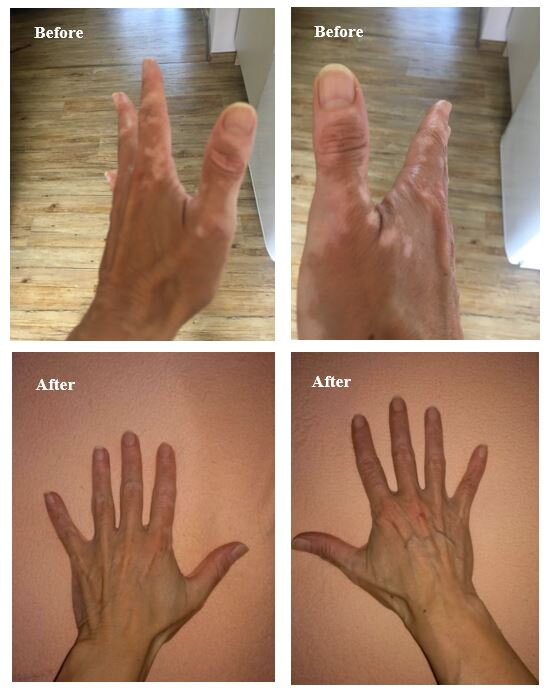
White spots on the backs of your hands, around the knuckles or on your wrists are often the first sign of vitiligo. Because your hands are visible all day long, these are usually the patches that bother people most. Here is the encouraging part: there is a clear, step-by-step approach to treating them, and many of our customers have regained pigment on their hands by sticking with it.
- The hands, wrists and fingers are some of the most common places for vitiligo to appear.
- Rubbing, minor injuries and frequent handwashing can trigger new spots, a reaction known as the Koebner phenomenon.
- Hands tend to respond more slowly than the face or neck. Think in months rather than weeks, and stay consistent.
- Treatment usually starts with a prescription cream or ointment from your dermatologist, followed by narrowband UVB light (311 nm), which can also be done at home with a handheld lamp.
- Sunscreen and good camouflage make everyday life easier while your skin repigments.
How to recognize vitiligo on your hands
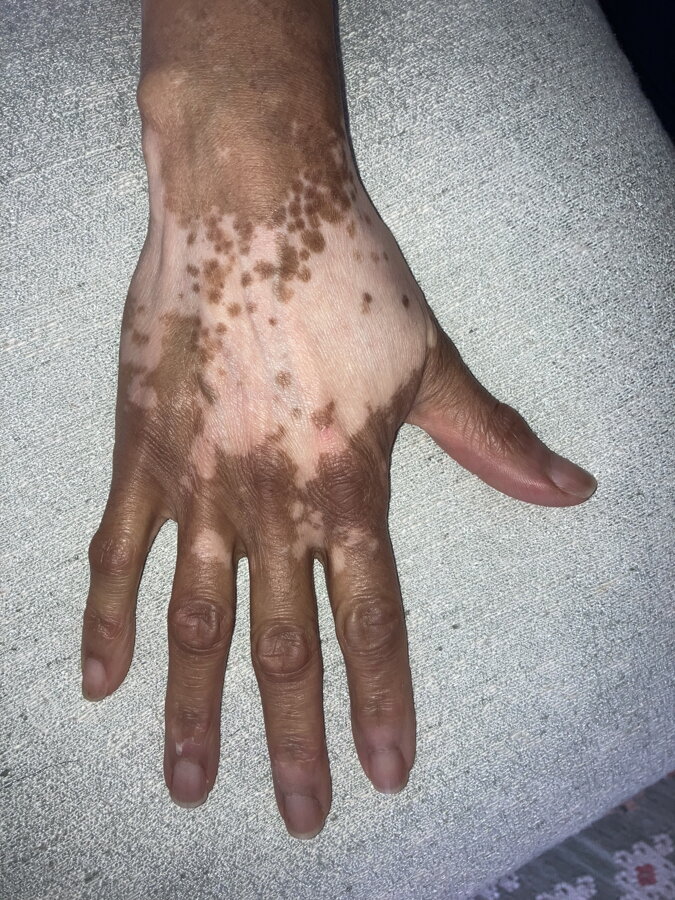
Vitiligo appears as milky-white patches with sharp borders where the skin has lost its pigment (melanin). On the hands it usually begins on the back of the hand, around the knuckles, at the wrists or on the fingertips, and it often affects both hands at the same time in a mirror-image pattern. The spots are painless and the skin feels the same as before; only the color changes. On fair skin they may be barely noticeable in winter, then stand out in summer as the surrounding skin tans.
If the spots itch, peel or turn red, ask your doctor to double-check the diagnosis. A fungal infection or light marks left behind by eczema can look similar.
Why vitiligo often starts on the hands
Vitiligo is an autoimmune condition, which means the immune system attacks the cells that make pigment (melanocytes) by mistake. Researchers still do not fully understand why it begins in one spot rather than another, but the hands share two features with other common vitiligo sites:
- Constant friction and small injuries. Rubbing, pressure, scrapes and burns, even a snug ring or watch band, can set off new patches in people who are prone to vitiligo. Dermatologists refer to it as the Koebner phenomenon.
- Lots of handwashing and strong cleaners. Dish soap, solvents and household cleaners dry out and irritate the skin. Some chemicals, including certain phenol-based products, can also trigger pigment loss.
That is why daily hand care deserves a place in your plan right alongside the treatment itself.
Treatment options for vitiligo on the hands
The guideline from the British Association of Dermatologists, one of the most thorough evidence-based reviews of vitiligo care, lays out a clear sequence. Your dermatologist will adjust it to your skin:
- Prescription creams come first. Away from the face, the usual starting point is a strong (potent) topical steroid used for a limited time, sometimes on an on-and-off schedule. Tacrolimus ointment may also be an option.
- Narrowband UVB light (311 nm). When creams alone are not enough, NB-UVB is the recommended light therapy, either at a dermatology office or phototherapy center or at home with a handheld lamp. For the hands, a handheld device is especially convenient: a session takes just a few minutes, and you skip driving to appointments two or three times a week.
- Combination treatment. Light therapy is often paired with a cream or ointment. According to the same guideline, the face and trunk generally regain color more readily than the hands and feet, so on the hands persistence is what counts most.
Newer, active patches usually respond better than spots that have been white for many years, so starting early is worth it.
At-home light therapy for hands: what our customers do
Customers who treat vitiligo on their hands at home typically rely on a handheld 311 nm UVB lamp and these steps:
- Apply Vitistop Gel to the patches and give it about 30 minutes to absorb.
- Treat your hands two or three times a week, with at least 48 hours between sessions. Begin with a very short exposure and increase the time gradually only if your skin is not pink the next day, exactly as the lamp manual describes.
- Take one Vitistop tablet daily. It contains copper, which contributes to normal skin pigmentation, along with zinc and other nutrients.
- Keep the patches from getting sunburned in summer, and snap a photo every four weeks so you can spot progress that is easy to miss from one day to the next.
Which lamp is right for you? The compact Philips BU-1S is our best-selling model, while the Philips BU-10 adds a built-in timer for precise dosing. You can compare every option under UVB light therapy and follow the full process step by step in our treatment guide.
Everyday tips to protect your hands
- Wear gloves for chores. Washing dishes, cleaning and yard work are much easier on your skin with gloves, which block friction, chemicals and small cuts.
- Choose a gentle soap and moisturize. Use a mild, fragrance-free hand wash and apply hand cream after every wash.
- Avoid rubbing. Tight rings, watch bands and bag handles that press on the same spot can trigger new patches.
- Use sunscreen. White patches burn quickly. Apply a broad-spectrum sunscreen with SPF 30 or higher, as the American Academy of Dermatology recommends, to the backs of your hands, including when you drive.
How to cover vitiligo on your hands
While your skin repigments, camouflage can do a lot for your confidence. On the hands, a self-tanner is often the most practical choice because it will not rub off on clothing and stays put through handwashing:
- Vitistop Self-Tanning Mousse develops a natural-looking color within a few hours, and it usually lasts five to seven days. The Mini Mitt helps you blend it precisely over the hands and knuckles.
- For instant coverage on a special occasion, browse our camouflage products.
Not sure where to begin with your hands? Send us a message about your skin. Peter, who has lived with vitiligo himself since 2016, and his team will help you put together a plan that fits.
Open the treatment guideFrequently asked questions
Can vitiligo on the hands go away?
Yes, pigment can return on the hands. Because hands respond more slowly than the face or neck, it usually takes several months of consistent treatment, typically a prescription cream plus narrowband UVB light, before repigmentation becomes obvious. Newer patches tend to respond better than older ones.
Why does vitiligo so often start on the hands?
Your hands deal with constant friction, minor cuts, frequent washing and chemicals. In people who are prone to vitiligo, this kind of irritation can trigger new patches, known as the Koebner phenomenon. This explains why vitiligo so frequently begins on the hands, wrists and fingers.
Is it safe to use a home UVB lamp on my hands?
Handheld narrowband UVB lamps emit the same 311 nm light used in dermatology offices. Start with very short sessions, add time only when there is no redness, protect your eyes and follow the manual. If you take any medication that makes your skin more sensitive to light, check with your doctor before you start.
How long does repigmentation on the hands take?
Everyone is different. Many people see the first small dots of pigment after a few months of regular treatment, while larger areas can take a year or longer. A photo every four weeks in the same lighting is the most reliable way to follow your progress.
What is the best way to cover vitiligo on my hands?
A self-tanning mousse such as Vitistop Self-Tanning Mousse gives a natural-looking tint that usually lasts five to seven days and holds up to handwashing. Cover creams and makeup work well for special occasions.
Vitiligo on other parts of the body
Sources: American Academy of Dermatology (AAD): Vitiligo – diagnosis and treatment; Eleftheriadou V. et al.: British Association of Dermatologists guidelines for the management of people with vitiligo 2021, Br J Dermatol 2022; U.S. Food and Drug Administration (FDA): Opzelura (ruxolitinib) cream – prescribing information; DermNet – Vitiligo.
This article is for general information only and does not replace medical advice. Vitiligo should be diagnosed by a dermatologist or your primary care doctor, and any new or changing patch of skin deserves a medical check. Our products are meant to support your skin care alongside the treatment your doctor recommends.