.jpg)
Vitiligo on the neck: what causes it, how to treat it and skin care tips
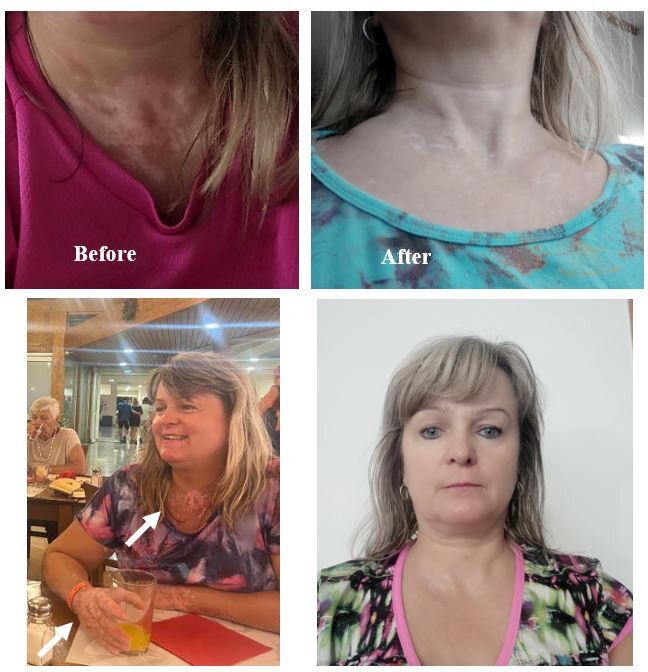
Patches on the neck often form exactly where a collar, scarf, necklace or seat belt rubs every day. They show with most outfits, especially in summer. The encouraging part: dermatologists find that the face and neck generally do better with treatment than hands and feet do, and photos from our customers show what steady care can achieve.
- Friction from collars, necklaces, scarves and straps often triggers or worsens vitiligo on the neck.
- Like the face, the neck generally responds well to treatment (DermNet, British Association of Dermatologists).
- Prescription creams come first, then narrowband UVB light (311 nm), which is easy to do at home with a handheld lamp.
- Vitiligo is more common in people with other autoimmune conditions, especially thyroid disease, so a check with your primary care doctor makes sense.
- Your neck gets sun almost all year round, so daily sunscreen matters.
How to recognize vitiligo on the neck
On the neck, vitiligo forms painless, milky-white patches with sharp edges. Typical places are the throat and the area under the chin, the sides where collars rest, and the nape along the hairline. Men may also notice white hairs in the beard area. It is common for neck patches to come with patches on the face, chest or shoulders.
Collars, chains and the Koebner phenomenon
If you are prone to vitiligo, constant rubbing, pressure or small injuries may cause new patches, an effect called the Koebner phenomenon. On the neck, the usual culprits are shirt collars and ties, necklaces, scarves, backpack and bag straps, seat belts and shaving. Small changes help: softer collars, lighter jewelry, a sharp razor with shaving gel, and not wearing the same tight top every day.
Separately, vitiligo shows up more often in people who have autoimmune thyroid disease. This has nothing to do with where the patches are, but if your thyroid has never been checked, it is a good question to bring up with your primary care doctor.
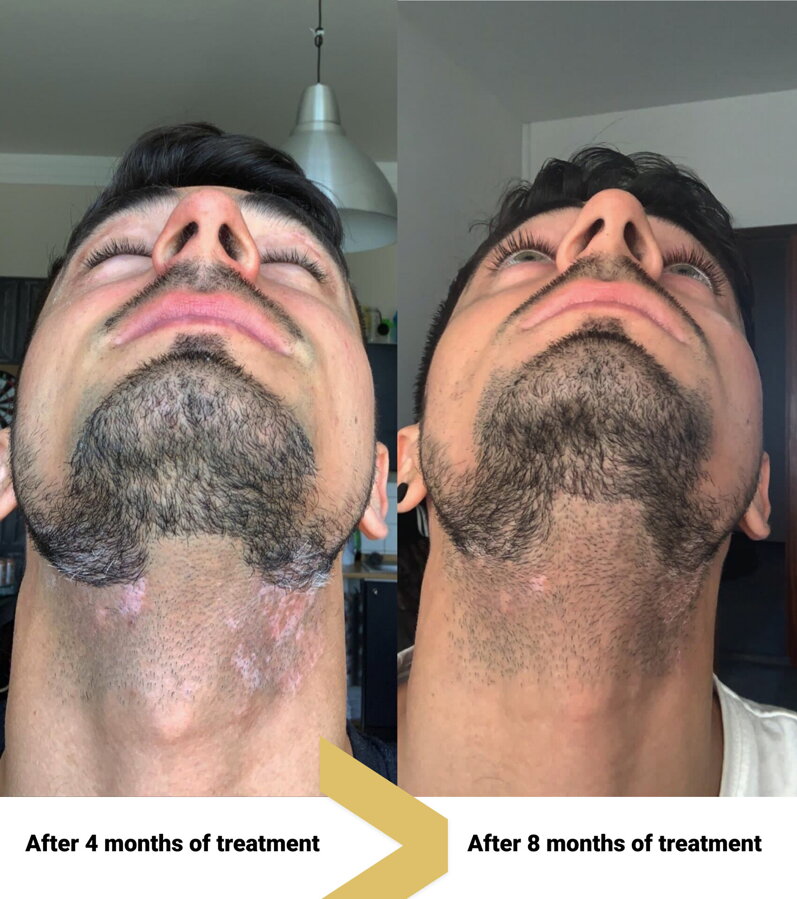
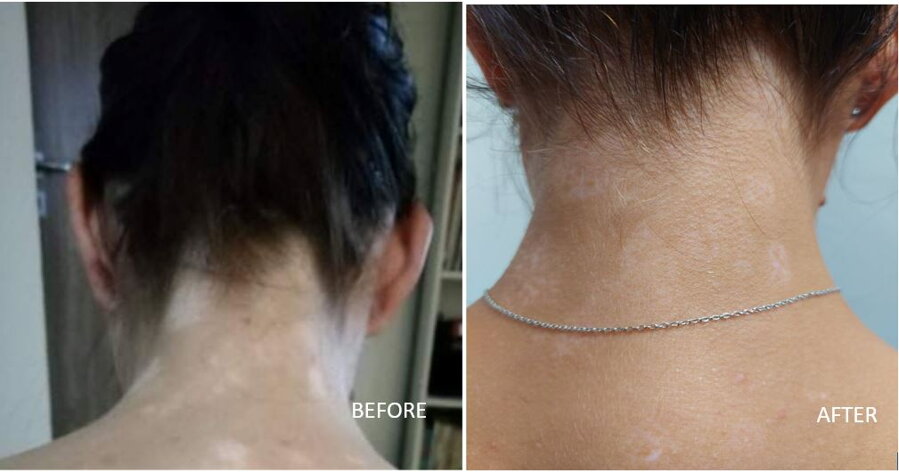
Treatment options for vitiligo on the neck
The British Association of Dermatologists guideline recommends beginning with a prescription cream: a potent topical steroid for a limited time, or tacrolimus ointment, a frequent choice for delicate skin such as the neck. If that is not enough, the next step is narrowband UVB phototherapy (311 nm), in a dermatology office or with a handheld device at home. Recent patches tend to react more quickly than long-standing ones, so early treatment is worthwhile.
Treating vitiligo on the neck at home
- About half an hour before each light session, smooth Vitistop Gel onto the patches.
- Treat your neck two or three times a week with a handheld 311 nm UVB lamp, leaving at least 48 hours between sessions. Start with a very short exposure and increase it only if your skin is not red the next day. Wear UV goggles, since the neck is close to your eyes.
- Have one Vitistop tablet every day; it contains copper, which contributes to normal skin pigmentation.
- Every four weeks, photograph the area in the same light to track changes.
The Philips BU-1S is easy to maneuver around the neck, and for the hairline or beard area, the comb attachment of the Kernel KN-4003BL2 gets light through to the skin between the hairs. Our treatment guide covers the full process.
Sun protection for your neck
The neck is one of the most sun-exposed parts of the body, and white patches burn quickly. A sunburn can make vitiligo spread, and tanned skin around the patches makes them more noticeable. From spring through fall, apply a broad-spectrum sunscreen with SPF 30 or higher, as the American Academy of Dermatology recommends, to your neck every day, including the back of the neck, which most people forget.
How to camouflage vitiligo on the neck
For the neck, a self-tanner beats makeup because it does not leave marks on your collar. Vitistop Self-Tanning Mousse develops a natural-looking color within a few hours that usually lasts five to seven days. Blend it with the Velvet Mitt, or use the Mini Mitt along the jawline and hairline. Let it dry completely before putting on light-colored clothing. See our camouflage collection for more products.
Would you like advice for your neck? Tell us about your skin. Peter, who has had vitiligo since 2016, and his team will help you work out the right approach.
Open the treatment guideFrequently asked questions
Why do I have vitiligo on my neck?
Vitiligo is autoimmune. On the neck, rubbing and minor skin damage from collars, necklaces, scarves, straps and shaving often set off new patches or make existing ones worse, an effect known as the Koebner phenomenon.
Does vitiligo on the neck respond to treatment?
Yes. Along with the face, the neck is one of the areas that usually responds better than the hands and feet. Prescription creams and narrowband UVB, either in the office or with a handheld lamp at home, are the main options.
Is vitiligo on the neck linked to the thyroid?
Vitiligo is more common in people with autoimmune thyroid disease, no matter where the patches are. If your thyroid has not been checked, ask your primary care doctor about it.
Can I use a UVB lamp on my neck at home?
Yes, a handheld 311 nm lamp works well on the neck. Start with very short sessions, increase the time only when there is no redness, wear UV goggles and follow the manual.
How do I cover vitiligo on my neck?
Self-tanning mousse works best here since it won't transfer onto collars. Expect the color to last five to seven days, and let it dry fully before getting dressed.
Vitiligo on other parts of the body
Sources: American Academy of Dermatology (AAD): Vitiligo – diagnosis and treatment; Eleftheriadou V. et al.: British Association of Dermatologists guidelines for the management of people with vitiligo 2021, Br J Dermatol 2022; U.S. Food and Drug Administration (FDA): Opzelura (ruxolitinib) cream – prescribing information; DermNet – Vitiligo.
This article is for general information only and does not replace medical advice. Vitiligo should be diagnosed by a dermatologist or your primary care doctor, and any new or changing patch of skin deserves a medical check. Our products are meant to support your skin care alongside the treatment your doctor recommends.