.jpg)
Vitiligo Treatment
Simple treatment protocol
A clear routine for supporting repigmentation
The routine combines controlled light exposure, topical support and daily nutritional support. Consistency is what makes it work — most visible progress comes after several months.
Last updated: 26 August 2026

Your first month
The daily routine
Tablets daily
After breakfast + evening meal
Gel before light
Apply to patches before every session
Light sessions
Monday · Wednesday · Friday
| Session days Mon · Wed · Fri | Rest days Tue · Thu · Sat · Sun | |
|---|---|---|
| Morning | 1 Vitistop Tablet after breakfast | 1 Vitistop Tablet after breakfast |
| Light | Apply Vitistop Gel 30 min before → NB-UVB lamp or sunlight (start at 30 sec, adults) | — |
| Evening | 1 Vitistop Tablet after meal · Protopic or Opzelura ~1 h before sleep (if prescribed), otherwise Vitistop Gel at bedtime | 1 Vitistop Tablet after meal · Protopic/Opzelura or Vitistop Gel at bedtime |
Protopic and Opzelura are prescription medicines — use only as directed by your doctor. Do not apply immediately before light exposure.
Repeat this pattern through weeks 2–4. Adjust your NB-UVB exposure for each area based on its skin reaction. Take comparison photos every 4 weeks.
Long-term plan
How the routine evolves month by month
Month 1
2 tablets/day
Light 3× per week
Month 2
1 tablet/day
Light 3× per week
Month 3+
1 tablet/day
Light 2× per week
Every 3 months
Take a 3–4 week tablet break, then restart the next cycle
Home NB-UVB phototherapy
Light therapy guide
Not suitable for everyone — check before starting
- Personal or strong family history of skin cancer — consult a dermatologist before using a home NB-UVB lamp.
- Photosensitivity or a light-sensitive condition (e.g. lupus, porphyria or severe reactions to sunlight) — requires medical clearance before any deliberate UV exposure.
- Medicines that increase light sensitivity — some antibiotics, retinoids and herbal products raise burn risk. Check with your pharmacist or doctor first.
Also seek medical advice before starting if you are pregnant, breastfeeding or have a serious active infection.
Starting your first session
- Apply Vitistop Gel to the white patches and wait 30 minutes.
- Switch on the NB-UVB lamp, or use controlled sunlight — never both on the same area on the same day.
- First session: 30 seconds (adults) · 15 seconds (children).
- Leave at least 48 hours between sessions. Only treat when any redness from the previous session has fully cleared.
Adjusting your dose
A mild skin reaction (slight redness, erythema) is the target — it typically appears 6–8 hours after exposure. Use the table below to decide what to do next session:
| Skin reaction the next day | What to do |
|---|---|
| No redness | Increase exposure by 20 seconds |
| Mild redness — clears within 24 h | Increase by 20 seconds |
| Noticeable redness — still slightly pink at 24 h | Keep the same time. Wait for the skin to fully recover before the next session. |
| Strong redness or discomfort | Pause treatment. When the skin clears, reduce by 20% and restart. |
Typical exposure per patch after several weeks: around 3–4 minutes, depending on skin type.
Eye area — separate rules apply
- Keep eyes fully closed during every session. Never look directly into a switched-on lamp.
- Treat each eye area separately, starting at up to 1 minute — not the 30-second body rule.
- If there is no mild next-day pinkness, increase by only 15 seconds per session (not 20 seconds as for body skin).
- Never re-treat eyelid skin that is still pink or irritated from the previous session.
Advanced option: Vitipro Gel for stubborn areas
For experienced adult users targeting difficult hand or foot patches during an autumn/winter NB-UVB routine, Vitipro Gel (Extra Strong) can be added as a night-time application. This is not for beginners — introduce it only after several months on the standard protocol. Apply Vitipro at night; at the next lamp session, start at half your usual exposure time and apply Vitistop Gel 30 minutes before the lamp as normal. Do not combine Vitipro with sunlight sessions.
Summer alternative
Using controlled sunlight
Apply Vitistop Gel 30 minutes before exposure. Start with 5 minutes and increase by 5 minutes per session when there is no redness the next day. The target is the same mild, temporary pinkness — typically 15–30 minutes in total, depending on skin type and season. Treat 2–3× per week with at least 48 hours between sessions.
Protect surrounding skin with SPF 50+ sunscreen from the start of every session, leaving only the selected patch unprotected during the measured window. After the exposure is done, apply SPF 50+ to the patches themselves before any further time outdoors.
Real treatment progress
Results with Vitistop Gel and sunlight
The photos below show progress on the hands — generally one of the hardest areas to repigment. The customer used only Vitistop products with controlled sunlight exposure.
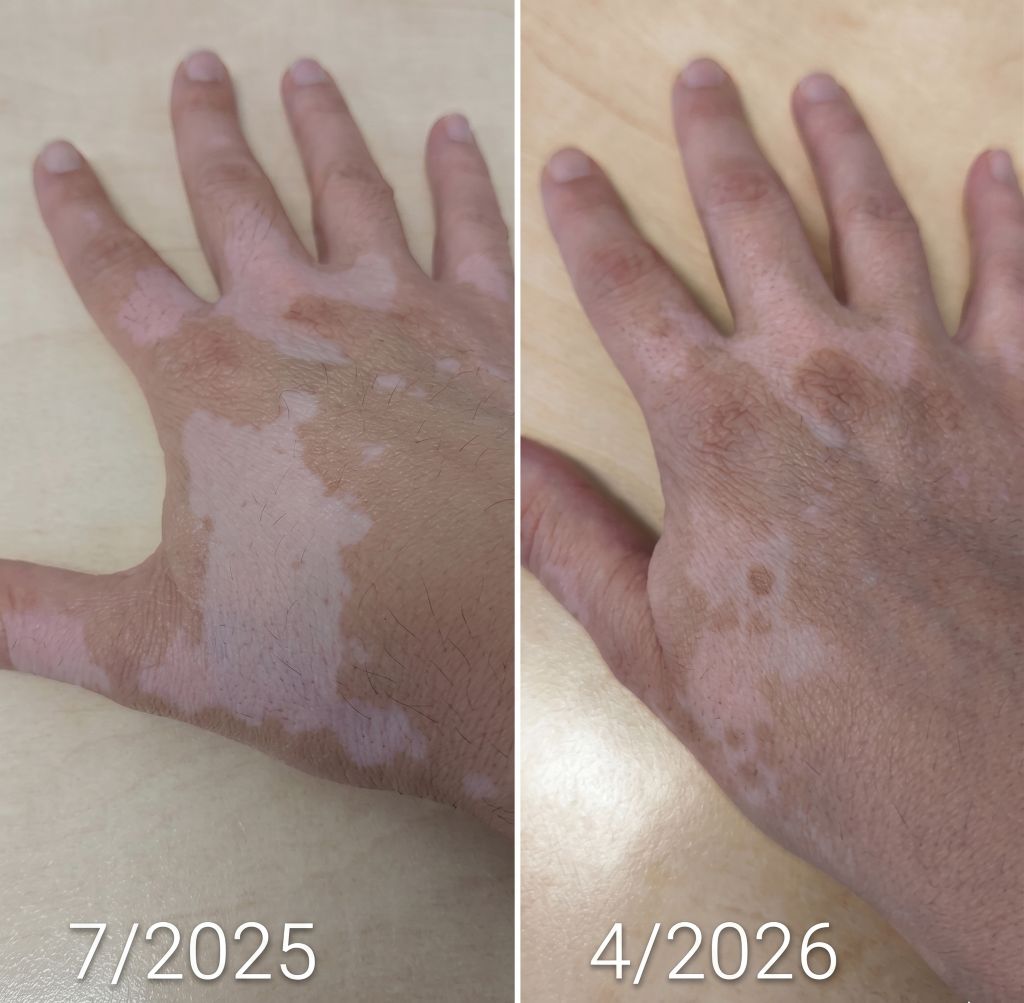
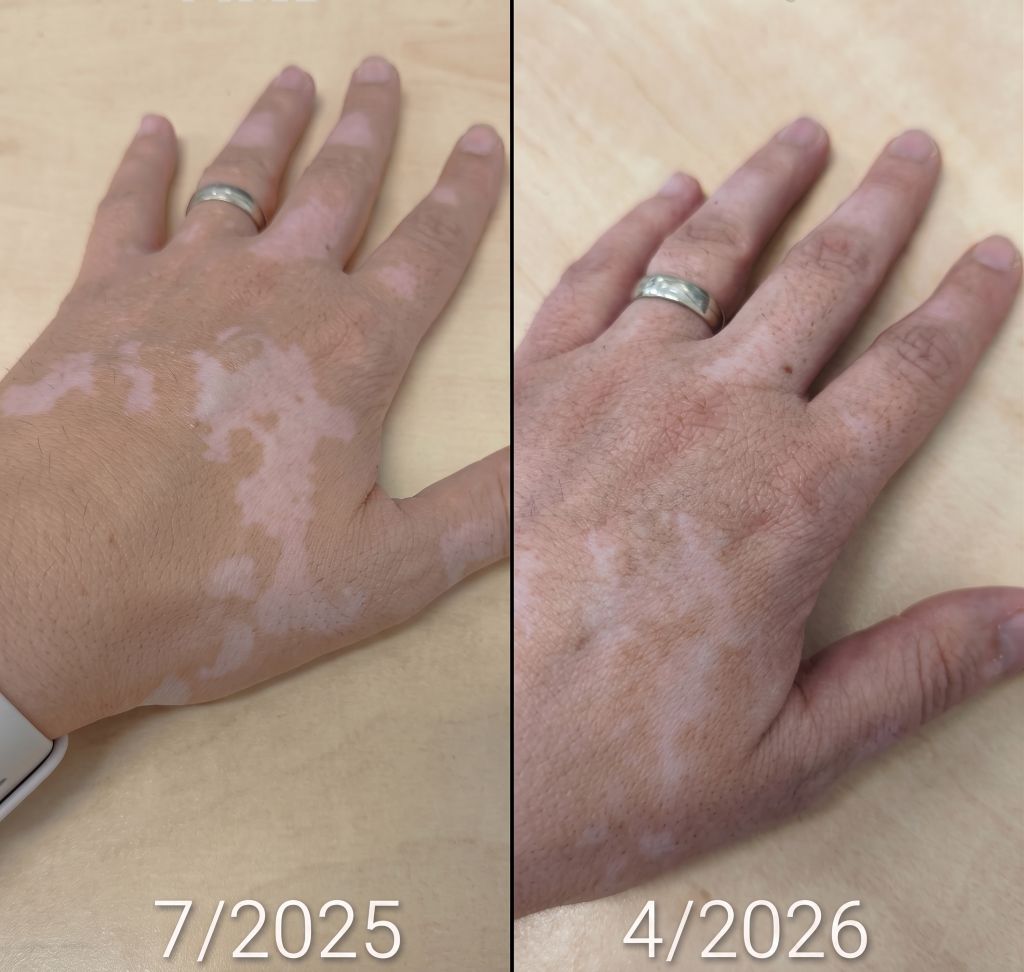
"I am more than satisfied with the product. The improvement is clearly visible, and it has made me feel so much better emotionally. ❤️ Thanks to you, I no longer have to hide my hands under the table." — Marta
The results might have been even better with prescribed Protopic alongside a 311 nm NB-UVB lamp during the winter months.
Supporting your treatment naturally
Lifestyle habits that help
None of these replaces the core protocol — they complement it by strengthening your immune system and creating better internal conditions for repigmentation.
Varied diet
Vitamins B12, D, E · copper · zinc · antioxidants — colourful vegetables, legumes, nuts.
Regular movement
Walking, cycling, swimming or yoga 3–5× a week. Reduces chronic inflammation over time.
Stress & sleep
7–8 hours sleep. Meditation, breathwork or outdoor walks — whatever genuinely helps you unwind.
Sauna & cold
Alternating heat and cold (sauna → cold shower or dip) improves circulation. Build up gradually.
Sun protection
Use SPF 50+ on all exposed depigmented skin every day — outside your treatment window. During a session, protect surrounding skin; apply SPF 50+ to the patch itself as soon as the window ends.
Gut health
Fermented foods, fibre and diverse plants support immune balance. Healthy gut, healthier skin.
Avoid friction & injury
Repeated rubbing, tight waistbands, harsh scrubbing or skin trauma can trigger new patches — especially on hands, feet and pressure points.
Not sure which routine fits you?
Answer 10 quick questions and we'll build a personalised treatment plan — or contact us directly and we'll help you choose.
This guide provides general information only and does not replace diagnosis, medical advice or the instructions supplied with an NB-UVB device or prescription medicine.