.jpg)
Vitiligo on fingers and fingertips: treatment, protection and coverage tips
White fingertips, pale knuckles or a light ring around a nail: vitiligo on the fingers is very common, and since you use your hands all day, it is hard to ignore. Of all body areas, fingers are usually the slowest to regain color. That is why this guide is all about practical steps: a realistic plan, solid protection for your skin and camouflage that lasts.
- Vitiligo very often affects the fingers, fingertips and knuckles.
- When patches show up on both the lips and the fingertips, the pattern is called acrofacial or "lip-tip" vitiligo.
- Fingertips have very few hair follicles, the main source of returning pigment, so they need the longest and most consistent treatment.
- Shielding your fingers from rubbing and small cuts lowers the risk of new patches.
- Self-tanning mousse adds natural-looking color to the fingers and stays on through handwashing.
Why vitiligo tends to affect the fingers
In vitiligo, the immune system destroys pigment cells. Patches like to form where skin is rubbed or nicked again and again, and hardly any part of your body is as busy as your fingers. Typing, gripping, washing, cooking, gardening: it all adds up. In people with a tendency toward vitiligo, this constant wear and tear may lead to new patches; doctors know this as the Koebner phenomenon. Finger patches often appear symmetrically on both hands.
Why fingertips repigment more slowly, and why treatment is still worth it
When vitiligo repigments, the color usually comes from pigment cells in the hair follicles, showing up as small brown dots that grow and merge. Hair follicles are nearly absent on the fingertips and the palm side of the fingers. On top of that, according to the British Association of Dermatologists, hands and feet are generally harder to repigment than the face and trunk. What this means in practice:
- the knuckles and the backs of the fingers, where fine hairs grow, tend to improve before the fingertips;
- color on the fingers often returns from the edge of a patch inward;
- treatment should be judged over many months, with a photo taken every four weeks.
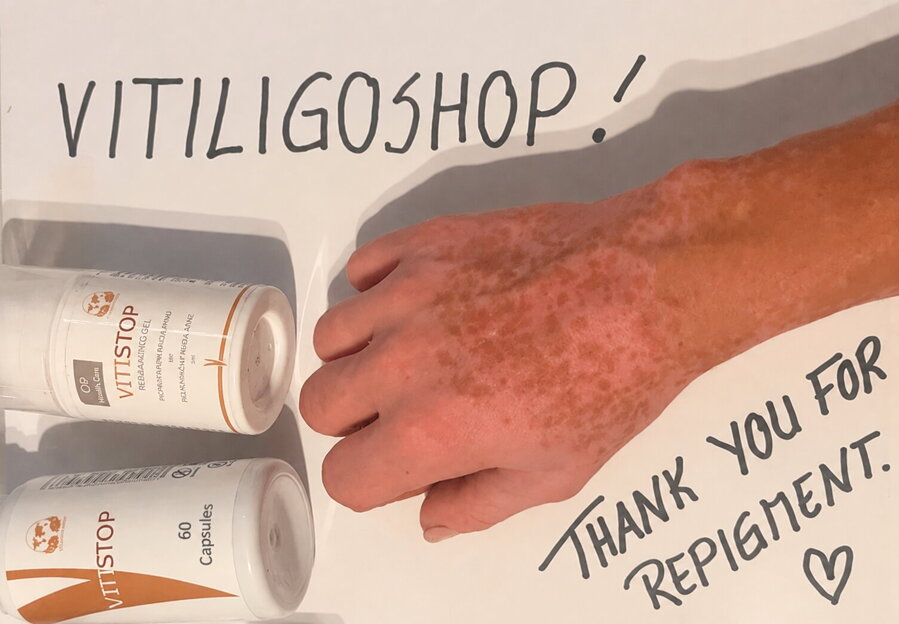
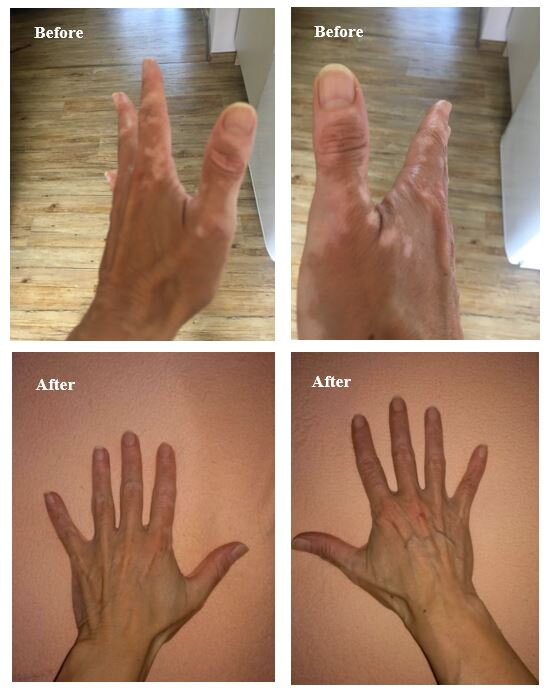
Slower does not mean impossible. Photos from our customers show that fingers can repigment too.
Treatment options for vitiligo on the fingers
Your dermatologist will usually start with a prescription cream, typically a potent topical steroid for a limited period or tacrolimus ointment. If that is not enough, narrowband UVB light (311 nm) is the next recommended step. Fingers are an ideal match for a handheld lamp because the treatment area is small: both hands take only a few minutes at home, two or three times a week.
Here is how many of our customers approach it:
- Spread Vitistop Gel over your fingers and knuckles and wait roughly half an hour.
- Use a 311 nm lamp, for example the Philips BU-1S or the Philips BU-10, two or three times weekly with at least 48 hours in between. Keep the first exposures very short and lengthen them only while the skin stays free of redness. Hold your fingers apart so light reaches the sides as well.
- Take one Vitistop tablet a day; copper contributes to normal skin pigmentation.
- Stay with it when progress seems slow; persistence pays off on the fingers more than anywhere else.
Our treatment guide walks you through the whole process week by week.
Protecting your fingers day to day
- Gloves for washing dishes, cleaning, DIY projects and yard work.
- No picking or biting at nails and cuticles, since small wounds can trigger new patches.
- Loose-fitting rings that do not rub the same spot all the time.
- Hand cream every time you wash, so the skin stays soft.
- Sun protection for your fingers and the backs of your hands whenever you are outdoors, because white skin burns fast. Choose a broad-spectrum sunscreen with SPF 30 or higher, as the American Academy of Dermatology recommends.
How to cover vitiligo on your fingers
Makeup rarely lasts on the fingers because we wash our hands so often. A self-tanner is far more durable. Apply Vitistop Self-Tanning Mousse using the Mini Mitt, using a cotton swab around the knuckles and nails; the color usually lasts five to seven days. Wash your palms afterward so they do not pick up color. You will find more options in our camouflage collection.
Have a question about your fingers? Message us. Peter has lived with vitiligo since 2016, and he and his team will gladly help.
Home UVB lampsFrequently asked questions
Why is vitiligo on the fingertips so hard to treat?
Returning pigment usually comes from pigment cells in the hair follicles. Fingertips have almost no hair follicles, so they regain color more slowly than the face, neck or backs of the hands. Repigmentation can still happen; it simply requires months of steady treatment.
What is lip-tip vitiligo?
Lip-tip, or acrofacial, vitiligo is a recognized form in which the lips and fingertips (and occasionally the toes) lose pigment. It is treated the same way as other nonsegmental vitiligo.
Can I use a home UVB lamp on my fingers?
Yes. A handheld 311 nm narrowband UVB lamp suits small areas such as the fingers well. Keep the first sessions very short, increase the time only when there is no redness, protect your eyes and follow the manual.
How can I keep vitiligo on my fingers from spreading?
Cut down on friction and minor injuries: wear gloves for chores, leave your cuticles alone, wear rings loosely and protect your skin from sunburn. Starting treatment early, while the patches are new, gives the best results.
How can I hide vitiligo on my fingers?
A self-tanning mousse applied with a mini mitt or cotton swab gives a natural-looking color that does not come off with handwashing and usually lasts five to seven days.
Vitiligo on other parts of the body
Sources: American Academy of Dermatology (AAD): Vitiligo – diagnosis and treatment; Eleftheriadou V. et al.: British Association of Dermatologists guidelines for the management of people with vitiligo 2021, Br J Dermatol 2022; U.S. Food and Drug Administration (FDA): Opzelura (ruxolitinib) cream – prescribing information; DermNet – Vitiligo.
This article is for general information only and does not replace medical advice. Vitiligo should be diagnosed by a dermatologist or your primary care doctor, and any new or changing patch of skin deserves a medical check. Our products are meant to support your skin care alongside the treatment your doctor recommends.